Cocoa Powder Screening
News 2026-06-21
Cocoa Powder Screening: Is 200-Mesh Vibrating Screen Really the Best Choice?
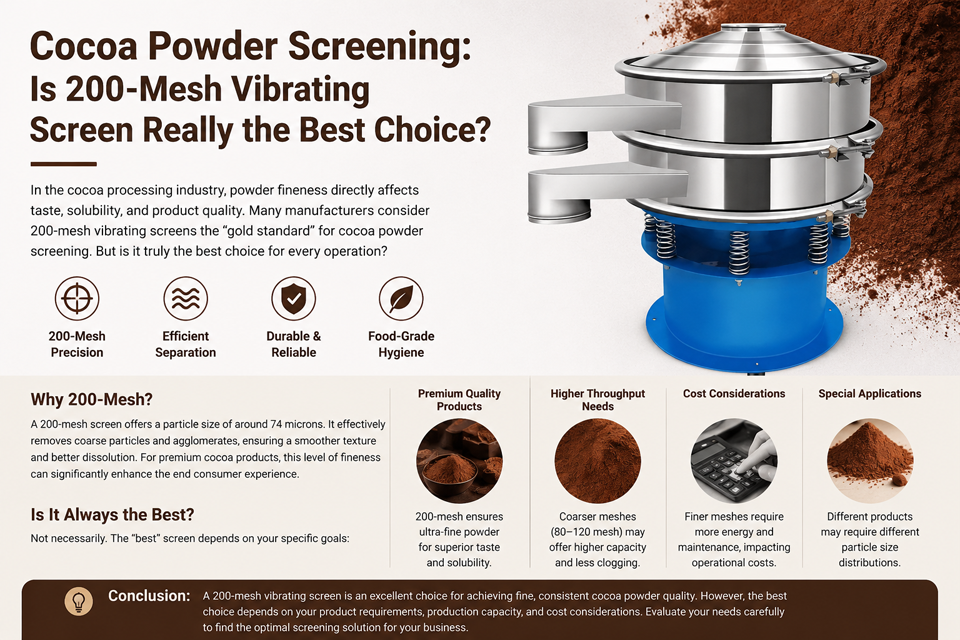
Yes. For cocoa powder fine screening, a rotary vibrating screen equipped with 200-mesh can achieve a balance between ultra-fine texture control and effective de-agglomeration, making it one of the most practical solutions in real production lines.
Why Does Cocoa Powder Need a Much Finer Screen Than Expected?
At first glance, cocoa powder is often assumed to be a simple “fine grading” material, where 40–80 mesh seems sufficient. However, real production shows a different story.
Cocoa powder contains natural fat, fine clumps, and micro-agglomerates formed during grinding and storage. These tiny clusters are not always visible but directly affect mouthfeel, solubility, and product consistency.
That is why real factory tests often push screening fineness much higher — even up to 200 mesh — especially when aiming for premium-grade cocoa products.
What Does the 200-Mesh Test Actually Tell Us?
In a recent factory demonstration using a XUANYU gyratory vibrating screen, cocoa powder was processed through a 200-mesh screen.
The result showed a clear difference:
Before screening: visible micro-clumps and uneven texture
After screening: finer, more uniform, and smoother powder consistency
This confirms an important fact: high-mesh screening is not just about size reduction, but about quality stabilization and agglomerate control.
Interestingly, the test also included a labeled sample comparison (“ANDRZEJ”), indicating a real customer validation scenario rather than a generic showroom demo. This adds practical credibility — the machine was tested with actual buyer material before shipment.
Why Rotary Vibrating Screen Works Better for Cocoa Powder?
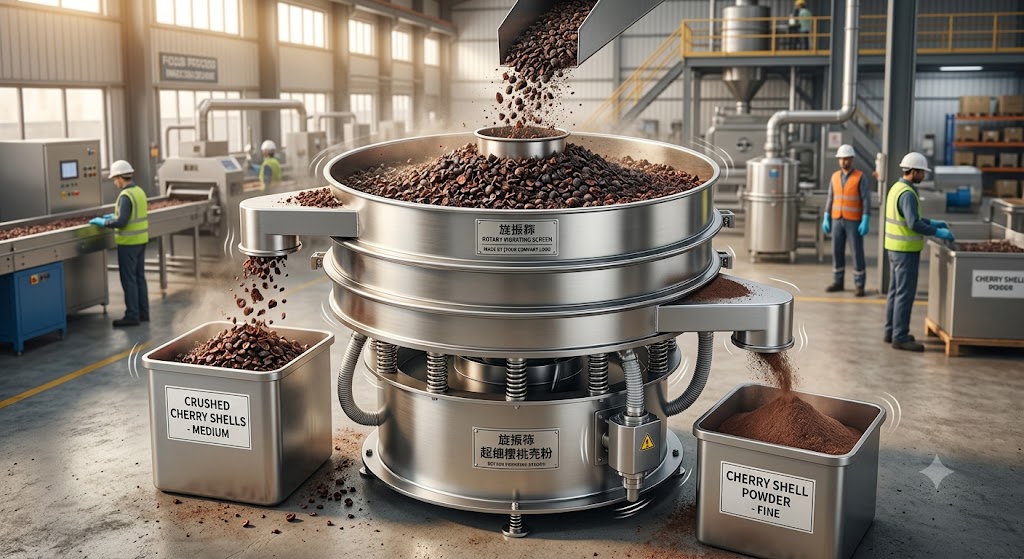
Cocoa powder behaves differently from dry mineral powders due to its fat content and light cohesion. A rotary vibrating screen is more suitable because:
Its three-dimensional vibration (horizontal + vertical + tilt motion) spreads material evenly across the mesh surface, preventing localized buildup. This reduces the risk of clogging, especially at high mesh levels like 200 mesh.
In addition, the gentle but continuous motion helps break soft agglomerates without damaging particle structure.
What Should Be Considered in Real Production?
However, the test also reveals what is not shown in short demo videos:
Anti-blinding systems (ultrasonic or ball cleaning) are critical for oily powders
Dust containment is necessary due to fine cocoa particle dispersion
Explosion-proof design should be evaluated for large-scale processing
Material contact parts must meet food-grade stainless steel standards
Without these configurations, even a 200-mesh screen cannot deliver stable long-term performance.
Final Conclusion
Cocoa powder screening is no longer just “size separation.” It is a quality control process that directly impacts product grade.
A properly configured rotary vibrating screen — especially with 200-mesh capability, anti-blinding systems, and enclosed design — provides a reliable solution for modern cocoa processing plants seeking higher consistency and premium output.
In real production, the best vibrating screen is not the coarsest or the finest, but the one that keeps quality stable batch after batch.
Answer:
Yes. For cocoa powder fine screening, a rotary vibrating screen equipped with 200-mesh can achieve a balance between ultra-fine texture control and effective de-agglomeration, making it one of the most practical solutions in real production lines.
Why Does Cocoa Powder Need a Much Finer Screen Than Expected?
At first glance, cocoa powder is often assumed to be a simple “fine grading” material, where 40–80 mesh seems sufficient. However, real production shows a different story.
Cocoa powder contains natural fat, fine clumps, and micro-agglomerates formed during grinding and storage. These tiny clusters are not always visible but directly affect mouthfeel, solubility, and product consistency.
That is why real factory tests often push screening fineness much higher — even up to 200 mesh — especially when aiming for premium-grade cocoa products.
What Does the 200-Mesh Test Actually Tell Us?
In a recent factory demonstration using a XUANYU gyratory vibrating screen, cocoa powder was processed through a 200-mesh screen.
The result showed a clear difference:
Before screening: visible micro-clumps and uneven texture
After screening: finer, more uniform, and smoother powder consistency
This confirms an important fact: high-mesh screening is not just about size reduction, but about quality stabilization and agglomerate control.
Interestingly, the test also included a labeled sample comparison (“ANDRZEJ”), indicating a real customer validation scenario rather than a generic showroom demo. This adds practical credibility — the machine was tested with actual buyer material before shipment.
Why Rotary Vibrating Screen Works Better for Cocoa Powder?
Cocoa powder behaves differently from dry mineral powders due to its fat content and light cohesion. A rotary vibrating screen is more suitable because:
Its three-dimensional vibration (horizontal + vertical + tilt motion) spreads material evenly across the mesh surface, preventing localized buildup. This reduces the risk of clogging, especially at high mesh levels like 200 mesh.
In addition, the gentle but continuous motion helps break soft agglomerates without damaging particle structure.
What Should Be Considered in Real Production?
However, the test also reveals what is not shown in short demo videos:
Anti-blinding systems (ultrasonic or ball cleaning) are critical for oily powders
Dust containment is necessary due to fine cocoa particle dispersion
Explosion-proof design should be evaluated for large-scale processing
Material contact parts must meet food-grade stainless steel standards
Final Conclusion
Cocoa powder screening is no longer just “size separation.” It is a quality control process that directly impacts product grade.
A properly configured rotary vibrating screen — especially with 200-mesh capability, anti-blinding systems, and enclosed design — provides a reliable solution for modern cocoa processing plants seeking higher consistency and premium output.
In real production, the best vibrating screen is not the coarsest or the finest, but the one that keeps quality stable batch after batch.