Vibrating Screen for Flour Screening
News 2026-06-18
What Is the Best Vibrating Screen for Flour Screening?
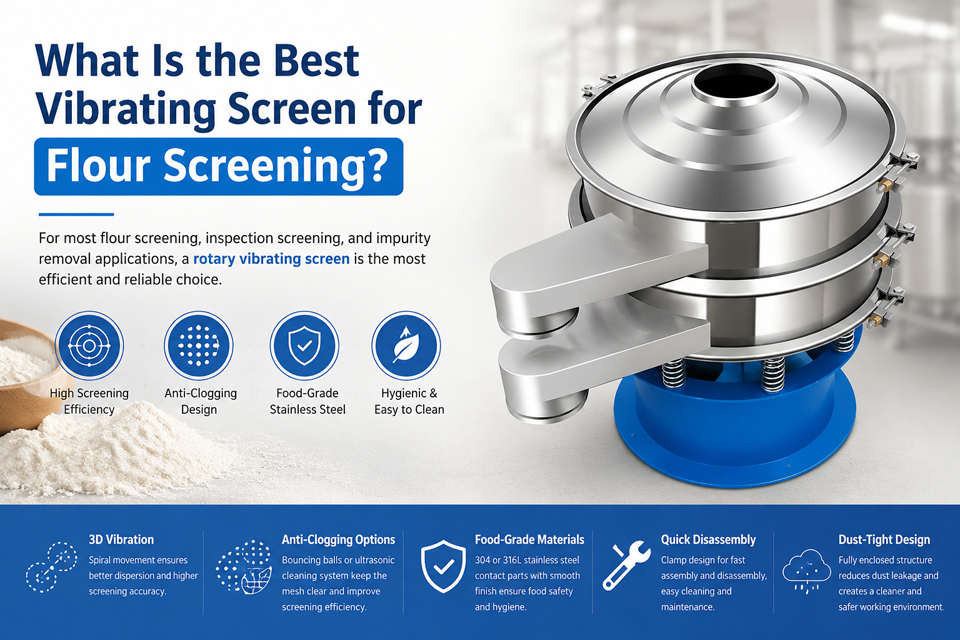
The answer is simple: for most flour screening, inspection screening, and impurity removal applications, a rotary vibrating screen is the most efficient and reliable choice.
Many food processing companies face the same challenges when screening flour: mesh blockage, insufficient throughput, dust leakage, and inconsistent screening accuracy. Although flour seems easy to handle, it actually places high demands on screening equipment. Its fine particle size, tendency to absorb moisture, and potential to form agglomerates make proper equipment selection critical for maintaining both productivity and product quality.
Why Is a Rotary Vibrating Screen Better for Flour?
Compared with a linear vibrating screen, a rotary vibrating screen uses three-dimensional vibration to move material in a spiral pattern across the screen surface. This motion effectively disperses agglomerated powder, improves screening efficiency, and reduces the risk of mesh clogging.
In practical applications, whether screening flour at 80–120 mesh or removing contaminants from finished products, rotary vibrating screens generally deliver higher throughput and more stable performance. This is why they have become one of the most widely used screening solutions in the food industry.
What Is the Most Important Factor in Flour Screening?
Many users focus only on mesh size, but anti-clogging performance is often even more important.
For standard dry flour, a bouncing ball cleaning system is usually sufficient to keep the screen mesh clear. For materials with higher moisture content, added nutrients, or oily ingredients, an ultrasonic screening system can provide continuous mesh cleaning and significantly improve screening efficiency.
It is also important to remember that finer mesh sizes reduce processing capacity and increase the risk of blockage. Therefore, screen diameter, screening area, and production capacity should always be considered together during equipment selection.
What Else Should Food Manufacturers Consider?
Food safety and hygiene should never be overlooked.
High-quality flour screening equipment is typically manufactured from food-grade 304 or 316L stainless steel. Polished contact surfaces help prevent material buildup, while quick-release designs simplify cleaning and maintenance, reducing downtime and ensuring compliance with food processing standards.
For continuous production lines, fully enclosed screening systems can also minimize dust emissions, improve workplace cleanliness, and reduce potential dust-related safety risks.
Conclusion
If your goal is flour inspection screening, impurity removal, or powder classification, a rotary vibrating screen is often the ideal solution, offering an excellent balance of screening accuracy, processing capacity, and hygienic design.
A well-designed food-grade rotary vibrating screen not only improves production efficiency but also helps manufacturers maintain consistent product quality, reduce maintenance costs, and achieve long-term operational reliability.